
This article contains affiliate links. We earn a small commission on purchases at no extra cost to you.
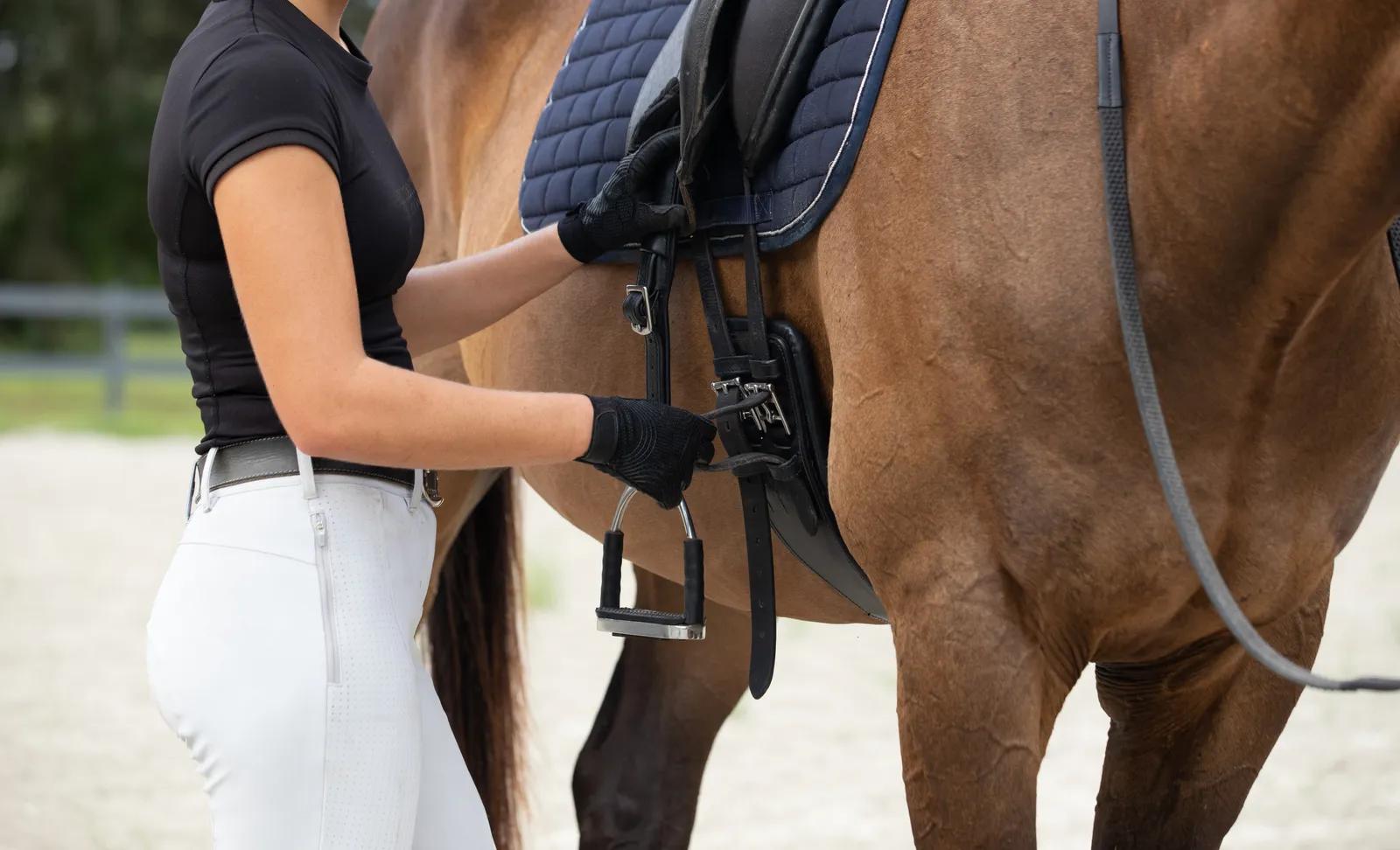
You spend months with a saddle fitter. You learn about tree angles and panel contact and flocking. You understand that a poorly fitted saddle restricts the shoulder, loads the spine, and tells the horse — through pressure he cannot escape — to move smaller, shorter, tighter. You get it right. And then you reach under the horse and buckle a girth that is three inches too long, made of a material that drags across the elbow, and shaped in a straight line across a body that is not straight.
The girth is not a passive piece of equipment. It is the anchor point of the entire system. Every rein aid, every weight shift, every movement the rider asks for passes through the saddle and is stabilized — or destabilized — by the girth. A saddle that fits correctly and a girth that fits poorly will produce a horse that moves as though neither fits.
Most riders own one girth. They bought it with the saddle, or inherited it with the horse, or grabbed the right length off the tack shop wall. They have never questioned it. This post is the reason to start.
The girth doesn't exist in isolation — it's part of a full leather system. Here's where to start if you're building or rebuilding your kit.
The Anatomy of the Girth Region
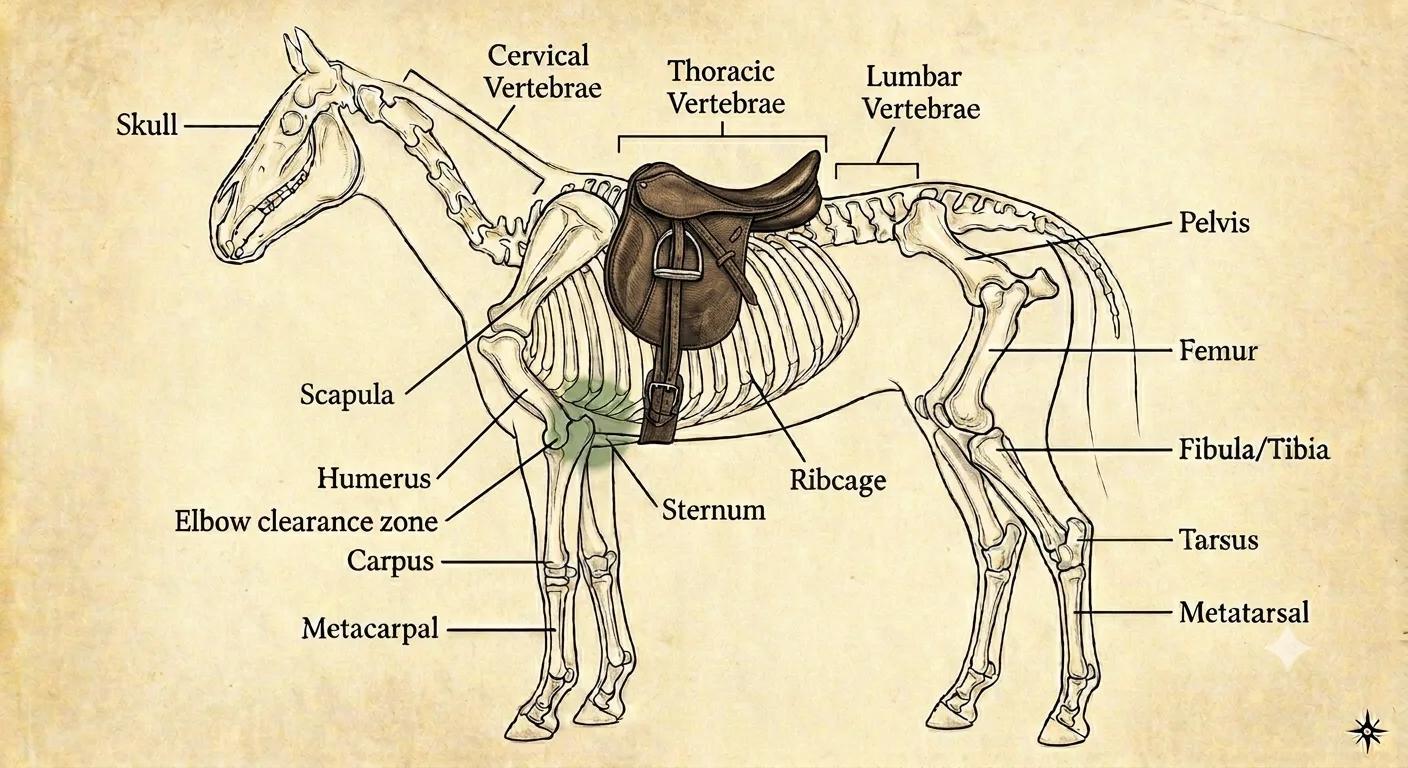
The girth sits in the girth groove — the natural channel behind the horse's elbow where the barrel begins to widen. This is not an arbitrary location. It is where the body's natural contour creates a stable resting point for a strap under tension. Understanding what sits in and around that groove explains every girth fit principle that follows.
The Girth Groove
The girth groove is not a single fixed point — it is a zone, roughly 2–4 inches wide, that begins just behind the elbow and extends toward the horse's flank. The front edge of that zone is the limit: a girth placed against or in front of the elbow interferes directly with the free forward swing of the foreleg. Every stride, the elbow moves back. Every stride, it contacts the girth. The horse learns to shorten his stride to avoid it, or develops a distinctive head-bob as the elbow contact registers as discomfort. Neither is a training problem.
The Pectoral Muscles
The pectoral muscles run along the horse's chest and connect the front legs to the sternum and ribcage. A girth that is too narrow, too stiff, or incorrectly shaped can create a pressure ridge across this muscle group, particularly in horses with forward-moving elbows or a wide chest. Restricted pectorals contribute to a choppy, restricted trot — the horse cannot fully extend because doing so increases pressure at a point that already hurts. This is misread as stiffness or laziness with remarkable consistency.
The Long Back Muscle and the Saddle Panel Zone
The girth buckles up through the billets and create a pressure point where they meet the saddle panel. In a correctly fitted system, that pressure point sits well forward of the long back muscle — in front of the 18th vertebra where the saddle tree ends. A girth that is too long brings the buckle hardware down into the panel zone, creating a hard pressure point directly over a muscle the horse needs to lift, swing, and engage through its whole topline. The buckles should sit at or above the widest part of the horse's belly — never in the middle of the barrel where they can migrate backward under the panel.
What Poor Girth Fit Actually Creates
The consequences of a poorly fitted girth do not announce themselves dramatically. There is no single obvious failure — instead, a cluster of symptoms that individually look like training problems, behavioral issues, or breed characteristics. Put them together and they point clearly at the girth.
1. Girth galls and sores. The most visible consequence and, paradoxically, not the most common. Girth galls — raw, hairless, sometimes open sores at the girth area — indicate sustained friction or pressure on a specific point. They are most common with girths that are too narrow (concentrating pressure on a thin line of tissue), made of materials that do not breathe, or fitted on a horse who has lost or gained significant weight since the girth was sized. A girth gall requires rest, healing, and a girth reassessment before the horse returns to work. Continuing to ride through a gall with a sheepskin cover is not a solution.
2. Girthiness and cold-backed behavior. A horse who pins his ears, swishes his tail, swings his head, or attempts to bite when the girth is tightened is not being difficult. He is communicating that tightening the girth hurts or is associated with pain. This behavior is also associated with ulcers, so a veterinary check is always the right first step. But a horse who is cinchy only with a particular girth, or whose girthiness appeared coincidentally with a new girth, is telling you something specific. Cold-backed behavior — bucking, humping, general tension in the first minutes of work — often resolves when girth fit is corrected.
3. Restricted shoulder movement. A girth placed too far forward, or with a straight shape that rides up into the elbow, creates a mechanical restriction on the forward swing of the foreleg. The horse cannot fully reach because the girth is physically in the way. This looks identical to a shoulder stiffness problem and responds poorly to physiotherapy because the cause is never addressed. The front feet land shorter, the rhythm flattens, and a horse who should float across a diagonal shuffles instead. Move the girth back by even one inch and, in many horses, the change in stride length is visible within a single circuit of the arena.
4. Lateral instability of the saddle. A girth that is too long, too elastic, or incorrectly shaped allows the saddle to slide sideways under load — particularly at the canter and over fences. The rider compensates unconsciously, weighting one stirrup more to keep the saddle centered, and the asymmetry creeps into their position and the horse's way of going. Saddle slipping is almost always attributed to a wither or back conformation issue before the girth is examined. Sometimes the wither is the cause. Often the girth is.
5. Back pain and topline tension. Buckle hardware sitting over the panel zone creates a hard pressure point on the long back muscle every time the horse moves. The back tightens around that pressure, the horse stops swinging through from behind, engagement disappears, and the rider calls the trainer. The trainer adds more leg. The horse gets tighter. The girth is never questioned. This chain of events is so common it is nearly a cliché in the world of saddle and girth fitting — and the fix, when a correctly sized girth is fitted, is often immediate and striking.
6. Asymmetric muscle development. A girth that applies uneven pressure — due to crooked billets, a warped girth, or a horse with asymmetric conformation that was never addressed — will cause the horse to load one side of his body differently than the other. Over months, this shows up as visible muscle asymmetry: one shoulder more developed, one side of the back softer, one hind leg tracking up less consistently. By the time the asymmetry is visible, the compensation pattern is well established. Catching and correcting girth fit early prevents this.
“A saddle that fits correctly and a girth that fits poorly will produce a horse that moves as though neither fits.”
Girth fit and bit fit solve for different parts of the same horse. If you're working through one, the other is worth reviewing at the same time.
Length: The First Variable to Get Right
Long Girth vs. Short Girth
English saddles use either a long girth (typically 42–56 inches, buckling below the saddle flap) or a short girth (typically 18–28 inches, buckling above the flap on longer billets). The choice is dictated by billet length — some saddles are made for short girths, some for long. Trying to use a long girth on a long-billet saddle, or vice versa, is not a preference issue. It is a fit issue with structural consequences.
Finding the Right Length
The functional test is simple: when the girth is buckled to its working holes — typically the middle third of the adjustment range — the buckles should sit at or above the widest part of the horse's belly. For most horses this is roughly at the level of the elbow, or slightly above. Buckles sitting below the belly's widest point are too low: they will migrate backward under the saddle panel with every stride and create the hardware-on-muscle problem described above.
If you are consistently buckling on the top holes to keep the buckles in the right place, the girth is too long. If you are consistently on the bottom holes and still feel the buckles sitting too high — pressing into the horse's side — the girth is too short. Neither extreme is optimal; both are common and both are worth correcting.
Seasonal Length Changes
Horses change shape meaningfully across the year. A horse who is well-muscled and full-bodied in autumn may be a noticeably different size in early spring after winter turnout. A horse in heavy competition work will be leaner through the barrel than the same horse at rest. Girth length requirements shift accordingly — sometimes by a full size. Owning two girths in adjacent sizes and adjusting seasonally is not overcautious. It is attentive horsemanship.
How to Measure for Girth Length
With the saddle in position and no girth attached: drape a soft tape measure through the left billet loop, bring it under the horse's belly, and up through where the right billet loop would hold it. The measurement from billet to billet, following the natural curve of the belly, gives you your working girth length. Add 8–10 inches if measuring for a short girth (to account for the long billets). This number is your starting point — round to the nearest standard size and err on the slightly longer side if you are between sizes, since you have more room to adjust upward than down.
Shape and Contour — Not All Girths Are Equal
A straight girth is a girth designed for a horse that does not exist. The barrel of every horse curves — wider at the belly, narrower where the girth groove meets the chest. A straight girth pressed against that curve creates uneven pressure: more at the center, less at the edges, and a tendency to migrate backward toward the widest part of the barrel. For some horses with a deep, barrel-shaped belly and naturally forward girth groove, this barely matters. For most horses, it matters quite a lot.
Anatomically Shaped Girths
Shaped girths — narrower at the front where they clear the elbow, wider and padded through the center where they bear the most weight — exist to solve this. The cutback at the front of the girth prevents elbow interference on horses with forward-moving legs or a girth groove that sits close to the elbow. The wider center distributes pressure across more surface area. For horses with a history of girth galls, tight pectorals, or elbow interference, a shaped or contoured girth is not an upgrade — it is a correction.
Straight Girths: When They Work
A traditional straight girth works well on horses with a naturally round barrel, a clearly defined girth groove well behind the elbow, and no history of girth-related movement restriction. Many horses go perfectly well in a straight girth for their entire lives. The point is not that straight girths are wrong — it is that shape is a variable worth understanding rather than defaulting on.
Straight Girth — Uniform width from end to end. Sits at the natural widest point of the belly. Can migrate backward on horses with a round barrel or forward girth groove. Best for: round-barreled, short-coupled horses with a well-defined girth groove.
Contoured / Shaped — Narrowed or cut back at the front to clear the elbow. Wider through the center for pressure distribution. Reduces interference on horses with forward movement or a girth groove close to the elbow. Best for: warmbloods, horses with active elbows, horses with girth gall history.
Dressage / Short — Designed for long-billet dressage saddles. Buckles sit above the saddle flap, eliminating bulk under the rider's leg. Length and shape follow the same fit principles as a long girth. Best for: dressage saddles with long billets; horses where thigh contact clarity matters.
Material and What It Changes
Leather
A well-conditioned leather girth is the standard against which others are measured. Leather conforms to the horse's body over time, breathes reasonably well, and — when maintained correctly — lasts for decades. It is not the right choice for a horse prone to girth galls (leather without padding concentrates pressure) or for disciplines where the girth gets wet repeatedly (leather stretches and weakens with repeated soaking and drying cycles). A leather girth that has not been conditioned is stiff leather — and a stiff girth against a soft belly is friction waiting to happen.
Fleece and Neoprene
Fleece — both natural sheepskin and synthetic — distributes pressure through compression and conforms readily to the horse's shape. It is a good choice for horses with sensitive skin or a history of girth galls, with one significant caveat: fleece traps heat and moisture. A horse who sweats heavily in work will have a wet, compacted fleece girth by the end of a session, and wet fleece against skin creates exactly the friction conditions it was supposed to prevent. Rinse and allow to fully dry between uses. Neoprene offers similar pressure distribution with better moisture management but less breathability — some horses find it uncomfortable in hot weather.
Mohair and Cotton
Natural fiber girths — mohair string, cotton cord — offer excellent breathability and moderate pressure distribution. They are a traditional endurance choice for exactly this reason: a horse working for eight hours in the heat needs a girth that breathes, dries quickly, and does not trap bacteria. The limitation is that natural fiber girths stretch and compress over time; they need to be checked and adjusted more frequently than leather or neoprene, and they have a shorter useful lifespan.
A Word on Elastics
Elastic inserts at one or both ends of the girth allow for expansion as the horse breathes and moves. In principle: less restrictive, more comfortable. In practice: elastic that is too wide or too stretchy allows the saddle to shift sideways under load. A small elastic panel — 3–4 inches — at one or both ends is genuinely useful. A girth that is primarily elastic, or that has lost its resistance and stretches dramatically under tension, is a saddle stability problem. If you can pull the elastic end of your girth several inches with moderate hand pressure, it has stretched beyond useful function.
Girth Tightness: How Tight Is Tight Enough
Tightness is the variable most riders think about least — and get wrong most consistently. The instinct is to tighten until the saddle feels immovable, and to do it all at once before mounting. Both habits create problems.
The Two-Finger Rule and What It Actually Means
A correctly tightened girth allows two fingers to slide under it — flat, not forced — at the center of the belly. Not one finger jammed sideways, not three fingers with room to spare. Two fingers, lying flat, moving freely from front to back. This ensures even pressure across the girth's surface without restricting the horse's ability to expand his ribcage as he breathes. At full work, particularly at canter and over fences, the horse's barrel expands significantly with each stride. A girth tightened beyond that range restricts breathing and creates the functional equivalent of exercising in a too-tight belt — tension through the body, shortened stride, resistance to impulsion.
The two-finger check should be done after mounting and after five minutes of walk work, not just on the ground. Horses bloat — deliberately or not — during tightening, and a girth that passed the ground check may need a hole or two once the horse has relaxed and you have moved off. This is normal. Check it, adjust it, and check it again.
Tightening Gradually — The Method That Matters
A girth should never go from loose to fully tight in one pull. Tighten one hole. Walk the horse forward four or five strides. Tighten another hole. Walk again. Repeat until you reach the working tension. This takes an extra ninety seconds and prevents two things: the skin fold that forms when a girth is yanked tight over unprepared skin, and the sharp behavioral response — ears back, swinging head, shuffling sideways — that many riders mistake for attitude and is almost always a pain response to sudden pressure.
Horses who are consistently cinchy often have a history of abrupt tightening. The behavior becomes anticipatory even after the handling improves, which is why it persists for months after you think you have solved it. Slow, consistent, incremental tightening — every ride — is the only way to rebuild neutral association.
Uneven Buckles: The Problem Nobody Mentions
Most English girths have two buckles at each end, connecting to two billets on the saddle. The assumption is that both buckles sit at the same hole. They often do not — and that asymmetry has consequences that run directly up into the saddle and the horse's way of going.
When the front buckle is tightened two holes higher than the back buckle, the girth is angled — higher at the front, lower at the back. This tips the bottom of the saddle panel forward, increasing pressure at the front of the tree and reducing contact at the back. The saddle pivots. The rider's weight shifts forward. The horse hollows his back in response to the changed pressure pattern. None of this is visible from the outside. It shows up as a horse who is consistently on the forehand, resistant to collection, or tight through the lumbar area — and it is corrected by evening the buckles.
After tightening, look at both buckle sets on each side before you mount. The holes should match. If they do not and the girth is the right length, the billets may be uneven — a saddle fitter issue. If the buckles are consistently uneven because that is the only way to get the girth to sit correctly, the girth length is wrong.
How Tightness Changes During Work
A girth that is correctly tightened at the start of a session may feel marginally looser after twenty minutes of work as the horse's muscles warm and relax and the leather or webbing settles slightly. This is normal, particularly with new girths or natural fiber girths, and it is why checking and adjusting at the walk before your first trot transition is good practice rather than overcaution.
What you should not find is a girth that has shifted position significantly — moved backward toward the flank, for example, or lifted at one end. Positional migration during work indicates a girth length or shape problem, not a tightness problem. Tightening further to compensate is the wrong solution and creates the buckle-pressure-on-panel issue discussed above.
How to Assess Your Girth Fit Today
Buckle position — buckles at or above the belly's widest point. With the girth at its working holes, the buckles should sit no lower than the widest part of the barrel. Slide two fingers between the buckle and the horse's side — there should be contact but no digging. If the buckles are level with or below the horse's stifle, the girth is too long.
Elbow clearance — at least two fingers between the elbow and the front of the girth. With the horse standing square, slide two fingers into the space between the point of the elbow and the front edge of the girth. Both fingers should fit without force. Ask someone to walk the horse forward while you watch — the elbow should swing freely without touching the girth on any stride.
Skin check — run your hand under the girth immediately after work. The skin under a correctly fitted girth should feel evenly warm and slightly moist — not hot in patches, not dry and rubbed, not showing a distinct pressure ridge. Any area of concentrated heat, hair loss, or skin sensitivity warrants investigation before the next ride.
Saddle stability — the saddle should not drift sideways at the canter. After a full schooling session, check whether your saddle has moved laterally. A small amount of movement is normal on a horse with an uneven topline; consistent drift to the same side with a well-fitted saddle points to girth elasticity, girth length, or billet symmetry. Note which direction the saddle drifts — it is usually away from the tighter or higher billet.
Behavior check — watch the horse while tightening, not after. Girthiness at the point of tightening is different from cold-backed behavior in the first minutes of work. The former is a discomfort response to the girth itself; the latter may be girth-related or may be back pain, ulcers, or saddle fit. Track when the behavior occurs and what it looks like — that information matters to your vet and your fitter.
Leather that fits correctly still needs to be maintained correctly. Here's the complete guide to caring for every material in your tack kit.
Frequently Asked Questions
How often should I replace my girth?
A well-maintained leather girth lasts 10–20 years with correct care. Synthetic girths have a shorter lifespan — neoprene and fleece typically last 3–7 years with regular use before the material compresses, loses structure, or the stitching begins to fail at the buckle guards. Inspect the stitching at the buckle guards and at the center of the girth once a season. Any fraying at a load-bearing seam is a reason to replace, not repair.
My horse has lost weight. Do I need a new girth?
Possibly. A horse who has lost condition through the barrel may need a shorter girth to keep the buckles at the correct height. Before buying, check your current adjustment range — if you have significant room to tighten and the buckles still sit in the right position, you may be fine for the current season. If you are at the outermost holes and the buckles are dropping below the belly's widest point, size down.
Should I buy a shaped girth or a straight girth?
A shaped girth is the safer default unless you've confirmed your horse has full elbow clearance with a straight one. Watch the horse walk and trot in the current girth — if you see any contact between the elbow and the girth on the forward swing, or notice the movement restrictions described above, switch to shaped. If clearance is clearly adequate and the horse moves freely, a straight girth that fits correctly in length isn't doing any harm.
Is double elasticating better than single?
Not necessarily. Double elastic — panels at both ends — allows more total expansion, which can be helpful on horses with barrel-shaped bodies or those who are particularly sensitive to girth pressure through the respiratory cycle. The risk is the saddle stability issue: more elastic means more potential lateral movement under load. If your current girth has double elastic and your saddle drifts, try single elastic before changing anything else.
My saddle fitter approved the saddle but the horse still isn't swinging through. What else should I check?
Start with girth fit and position — it's the most commonly overlooked variable in back tightness. From there: bit fit and contact, dental health, ulcers, and hind limb soundness. A saddle fitter who knows your horse and saddle well will often have a preferred girth type for that specific combination; it's worth asking directly rather than waiting for them to volunteer it.
The Elevated Tack Room Lookbook
15 finds every equestrian actually needs — curated, tested, and worth every penny. Free when you join the list.
No spam. Unsubscribe anytime.
Done
You're on the list. Check your inbox — your guide is on its way.