
This article contains affiliate links. We earn a small commission on purchases at no extra cost to you.
Finding a horse riding instructor you can trust comes down to four checks: real credentials, how they teach a lesson you watch, how they handle fear, and how their current students ride. This guide walks through each one — plus the red flags that should end the conversation.
Why the instructor matters more than the barn
The arena footing, the lesson horses, the view from the indoor — none of it matters as much as the person standing in the middle of it.
A skilled instructor shortens the learning curve by years. They see the problem before you feel it. They find the words that make something click. And they build the kind of trust that keeps you coming back when the sport gets hard, because it will get hard.
The wrong instructor does the opposite. A few months with someone who yells, dismisses questions, or pushes past fear can undo more than just your position. It can end your time in the saddle entirely.
So finding the right person deserves more rigor than checking who has availability on Saturday mornings.
What credentials actually mean (and what they don't)
Certification signals training and accountability — not talent.
In the United States, look for instructors certified through the USDF (United States Dressage Federation) for dressage, USEF (US Equestrian Federation) for hunter/jumper or eventing, or CHA (Certified Horsemanship Association) for general English and Western instruction. CHA certification includes a meaningful safety component, which matters especially if you're a newer rider. BHS (British Horse Society) qualifications are highly regarded internationally and occasionally held by instructors in the US.
What certification tells you: this person completed formal training, passed an evaluation, and agreed to a code of conduct. What it doesn't tell you: whether they're a good communicator, whether their teaching style suits you, or whether they actually care about your progress.
Some of the best instructors in the country hold no formal credential. Some certified instructors are mediocre teachers. Credentials are a useful filter, not a guarantee.
Use them to build a shortlist. Then watch someone teach before you book.
How to evaluate a lesson before you commit
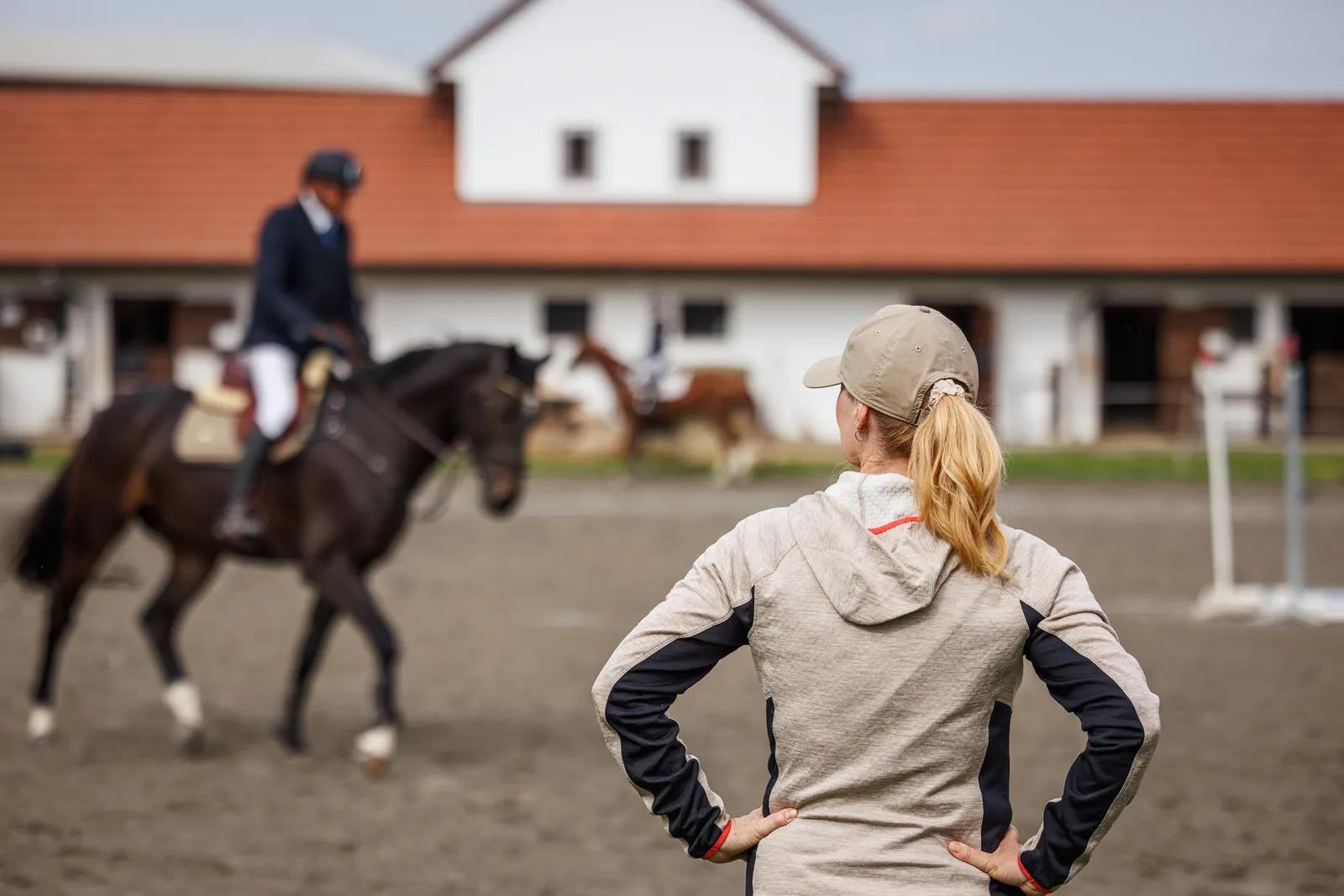
Ask if you can observe a lesson with one of their current students before booking your own. Most instructors will say yes. A refusal is worth noting.
Watch for these specific things:
How they communicate feedback. Are instructions specific ("close your fingers on the rein, don't pull back from the elbow") or vague ("more forward, softer hands")? Specific feedback accelerates learning. Vague feedback leaves students guessing.
How they handle a mistake. Do they explain what happened and offer a correction, or do they repeat the same instruction louder? Patience is a skill, and it's visible from the rail.
How the horse looks. Lesson horses work hard. A good program keeps them willing and forward. A horse that pins its ears, drags its feet, or swishes its tail constantly is telling you something about the environment it works in.
Whether the student leaves with something. At the end of the lesson, did they get one clear takeaway? Or were they bombarded with corrections and left feeling worse than when they started?
“The best instructors make you feel like progress is possible — and then they show you exactly how to get there.”
Questions to ask before booking your first lesson
A brief conversation before you commit tells you more than a website bio. Ask:
- What does a typical lesson look like for a rider at my level? A good instructor can describe the structure clearly — warm-up, work phase, cool-down, debrief.
- How do you approach fear or confidence issues? The answer to this one matters enormously. You want someone who takes it seriously without making it a bigger deal than it needs to be.
- How many students do you teach per week? An instructor with 40 students and no assistant may not have the bandwidth to track your progress session to session.
- What do you expect from your students between lessons? This tells you about their teaching philosophy — whether they see lessons as isolated events or as part of a longer development arc.
- How do you handle it when a rider and a horse aren't a good match? Good programs have flexibility. Watch for defensiveness about their horses.
- Do you have experience teaching [your discipline] at [your current level]? Obvious, but worth asking directly.
Green flags: what a trustworthy instructor looks like
Specific positive indicators are harder to name than red flags, but they're just as important to look for.
A trustworthy instructor gives feedback that's progressive — each lesson builds on the last rather than covering the same ground week after week. They remember what you worked on previously without being reminded.
They can explain why, not just what. "Close your leg here because your horse needs to stay straight through his shoulder, and without that support he'll fall out" is a different level of instruction than "more leg."
They celebrate small progress. Not effusively — just honestly. "That transition was cleaner" means something when it's said plainly and accurately.
They talk about feel as well as position. Geometry and angles matter, but feel is what allows you to ride any horse, not just the one you know. An instructor who only corrects what they can see from the ground is missing half the conversation.
Understanding what your lessons are building toward — the six-element framework that underpins how every horse learns to carry a rider — gives you a way to measure whether a teaching relationship is actually moving forward.
And they're honest with you. About what's working, what isn't, and what it's going to take.
Red flags: when to walk away
Some of these are obvious. Some aren't.
Yelling or public humiliation. There is no pedagogical justification for it. If an instructor raises their voice at a rider in front of others, leave.
Refusing to explain. "Just do it" is not instruction. If a student asks why and the answer is "because I said so," that instructor is not teaching — they're performing authority.
Pushing past fear. A good instructor acknowledges fear and works through it methodically. An instructor who dismisses it, mocks it, or uses it as a test of commitment is creating a safety problem and a psychological one.
Prioritizing results over the horse's welfare. If a horse is clearly uncomfortable — pinned ears, wringing tail, resistance — and the instructor's response is to push harder rather than investigate, pay attention. How someone treats animals when they're having a hard day tells you a great deal.
What a good instructor builds over time is something more than technique — it's the quality of attention and trust that makes a horse willing to work. That relationship, and how to build it outside of lessons, is worth understanding from the start.
Inconsistent expectations. If the rules, the feedback, and the standards seem to shift depending on the day or the rider, the teaching lacks structure. Progress requires consistency.
Spending more time in your saddle than you do. There is real value in an instructor occasionally getting on your horse — to feel what's happening, to understand the horse better, and to return to you with more specific guidance. That is good teaching. The red flag is when it becomes a pattern: the trainer rides, the horse performs, and you watch from the fence. If your instructor can get your horse to do something but cannot communicate how to get there yourself, they are training your horse — not teaching you. Unless your only goal is the horse's performance, you should be the one in the saddle. Growth in this sport comes from doing, not watching someone else do it for you.
Encouraging isolation. Be cautious of any instructor who discourages you from watching other instructors work, attending clinics, or seeking outside perspectives. Confidence in teaching doesn't require a closed ecosystem.
Discipline fit: finding someone who teaches what you want to ride
Methodology differs significantly across disciplines, and early training shapes everything that follows.
A dressage instructor and a Western pleasure trainer are both teaching riding — but the seat, the contact, the aids, and the philosophy behind them are different enough that crossing them early creates confusion. An eventing coach and a show hunter coach may sit differently, use their leg differently, and disagree fundamentally on pace.
This isn't about one discipline being better. It's about finding someone whose foundation matches the direction you want to go. If you want to compete in dressage, you want a dressage instructor from the start. If you're still deciding, find someone with a broad background who can explain how different disciplines approach the same problems — and who won't steer you toward their preferred one at the expense of your own curiosity.
The trial lesson: what to pay attention to
Book a single lesson before committing to a package or a program.
During the lesson, notice whether the instructor is responding to you specifically — your body, your horse, your way of processing feedback — or whether they're running a standard script. The best instruction is responsive. It adjusts.
Notice how you feel in the saddle. Not comfortable in the sense of easy — riding is work — but whether you feel supported and clear. A good lesson leaves your body with something to think about. It doesn't leave you tense, confused, or discouraged.
After the lesson: did you leave with one clear thing? One feeling to come back to, one adjustment to carry into your next ride? If yes, that's a good sign. If you left with eight corrections and no sense of where to start, the lesson may have been more about the instructor's knowledge than your development.
A few days later, ask yourself whether you want to go back. That answer is often cleaner than anything you analyzed in the moment.
When to move on
A good instructor relationship has a natural arc. You learn, you improve, you may eventually reach the edge of what that particular teacher can offer. That's not a failure — that's growth.
It's also possible to realize, months in, that the fit simply isn't right. The teaching style doesn't match how you learn. The discipline focus has shifted. The relationship dynamic has become uncomfortable. These are all legitimate reasons to make a change.
The only version of instructor-switching that creates a problem is doing it so frequently that nothing accumulates — changing every few months because progress feels slow, or chasing a different approach every time something is hard. Consistency over time is where real riding development happens.
There is one situation that makes leaving more complicated: when your instructor is also the trainer at your boarding barn and outside trainers are not permitted. In that case, moving on means more than finding a new teacher — it means finding a new barn. That is a bigger decision, with more logistics, more cost, and more disruption to your horse's routine. It is also, almost always, worth it. Your development as a rider matters. Do not let barn politics keep you in a teaching relationship that has stopped serving you.
When it's time to move on, most instructors understand. A simple, direct conversation is enough. You don't owe anyone an elaborate explanation.
Find the next person with the same care you used to find the first.
The instructor is one of three relationships — alongside the farrier and the vet — that determine whether the first year of horse ownership goes well. If you're building that foundation from scratch, the complete guide walks through all of them.
Frequently Asked Questions
How do I find a riding instructor near me?
Start with discipline-specific organizations: USDF (dressage), USEF (hunter/jumper and eventing), or CHA (general). Their instructor directories list certified professionals by region. Local boarding barns also keep referral lists, and asking at a feed store or tack shop often surfaces names that don't show up online.
What certifications should a riding instructor have?
It depends on the discipline. For dressage, USDF certification is the gold standard. CHA (Certified Horsemanship Association) certifies instructors across disciplines and includes a safety component. In the UK, BHS (British Horse Society) qualifications are highly regarded. That said, certification is a floor, not a ceiling — some exceptional instructors teach without formal credentials. Watch a lesson before you commit.
How often should I take riding lessons?
Once a week is the minimum for real progress. Twice a week — if time and budget allow — is where most riders see meaningful improvement. Anything less than weekly makes it hard to build muscle memory and feel between sessions.
Is it okay to switch riding instructors?
Yes. You may outgrow an instructor, change disciplines, or simply find that the teaching style doesn't suit how you learn. A good instructor will understand. The only thing worth avoiding is jumping between instructors so frequently that you never build on anything — consistency matters as much as fit.
What should I look for in a first riding lesson?
Pay attention to how the instructor explains things (clear and specific vs. vague), how they handle a mistake (constructive vs. dismissive), and how the horse they use appears (calm and willing, not sour or tense). You should leave with one clear, actionable thing to practice.
The Elevated Tack Room Lookbook
15 finds every equestrian actually needs — curated, tested, and worth every penny. Free when you join the list.
No spam. Unsubscribe anytime.
Done
You're on the list. Check your inbox — your guide is on its way.