
This article contains affiliate links. We earn a small commission on purchases at no extra cost to you.
“The six pillars have been tested on every horse, in every discipline, for centuries. They have never been improved upon. Only ignored.”
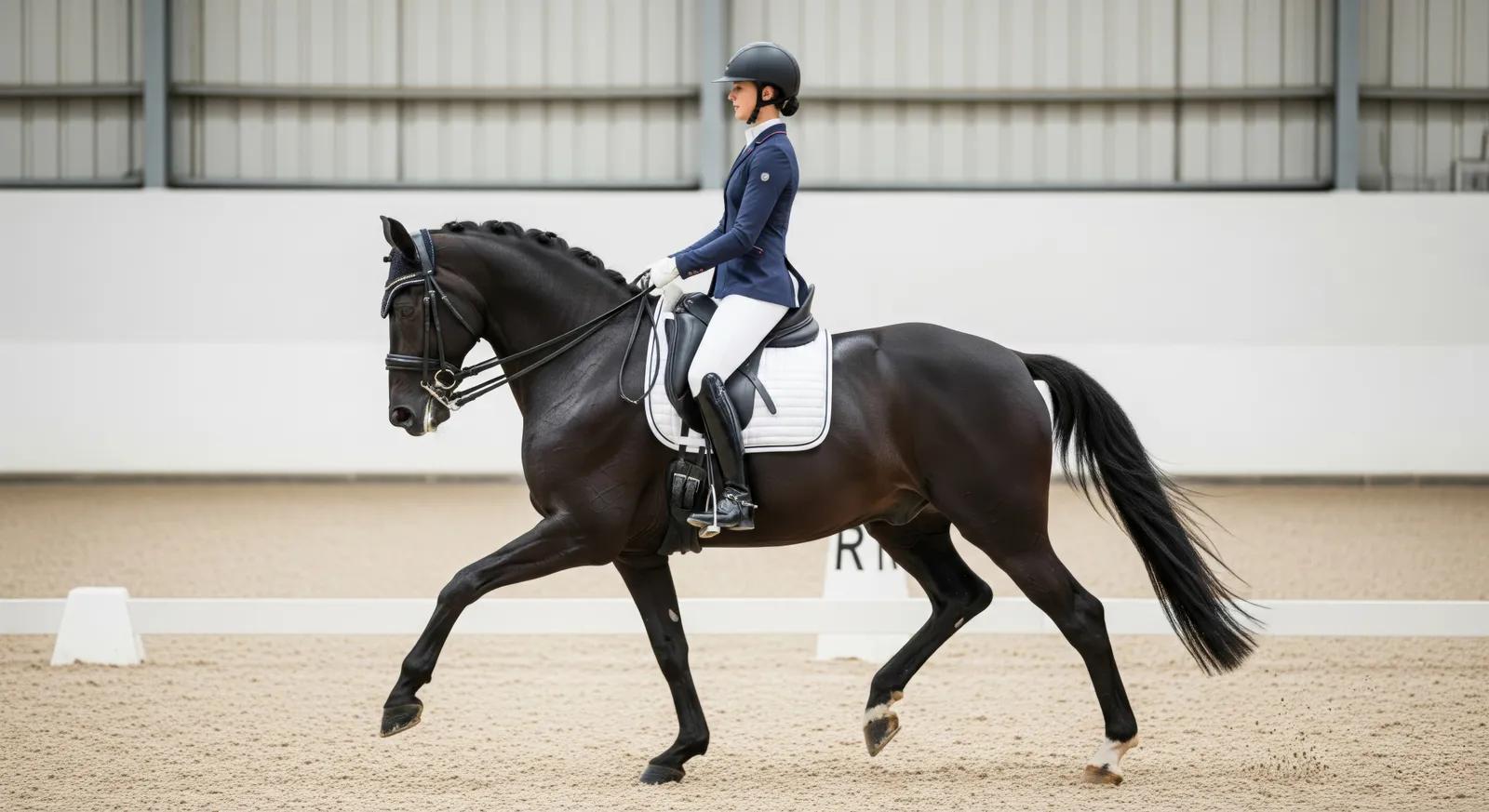
The equestrian Training Scale — six qualities that define how a horse learns to carry a rider correctly — is the oldest, most rigorously tested framework in equestrian sport. It is not a dressage concept. It is the foundation of every well-trained horse, in every discipline.
Xenophon wrote about it in 360 BC. The German National Equestrian Federation codified it in the 20th century. Every FEI judge scores against it today.
Most riders have heard the six words: rhythm, suppleness, contact, impulsion, straightness, collection. Few understand what they actually mean in the body — the horse's body, and their own. Fewer still know how to feel whether they've achieved each quality before moving on to the next.
This is the deep read.
What the Training Scale Actually Is
The Training Scale (Skala der Ausbildung in German) was formally codified by the Deutsche Reiterliche Vereinigung — Germany's National Equestrian Federation, known as the FN — in their official training manual, Principles of Riding. It represents the accumulated methodology of classical European horsemanship, refined over centuries and formalized into a systematic progression.
The FEI (Fédération Equestre Internationale), the governing body of international equestrian sport, embedded the Training Scale directly into its dressage judging criteria. Every movement in every FEI dressage test is evaluated against these six qualities.
The scale is often depicted as a pyramid, with Rhythm at the base and Collection at the apex. That visual is accurate but slightly misleading — it suggests a strict linear progression, when the qualities are deeply interdependent. Lose rhythm under pressure and suppleness collapses with it. Develop true straightness and impulsion improves without being separately asked for. The six pillars support each other in both directions.
The FN groups them into three phases:
- Familiarization: Rhythm + Suppleness
- Development: Contact + Impulsion + Straightness
- Culmination: Collection
You work through them in order. You never stop working on the ones below.
“"For what the horse does under compulsion is done without understanding; and there is no beauty in it either, any more than if one should whip and spur a dancer." — Xenophon, *On Horsemanship*, ~360 BC”
If you're still getting your footing as a horse owner, the Training Scale will make more sense once the bigger picture is in place.
Rhythm: The First Pillar of the Training Scale
The FEI defines rhythm as the regularity and evenness of all steps, strides, and jumps.
This means the correct number of beats, in the correct sequence, at a consistent tempo. Not sometimes. Every stride.
Walk: Four beats, lateral sequence. Left hind, left fore, right hind, right fore — each foot strikes the ground individually, in that order, with no moment of suspension. A horse that paces — moving both legs on the same side simultaneously — has lost the four-beat walk entirely. It is one of the most serious rhythm faults in the walk, and one of the hardest to correct once established.
Trot: Two beats, diagonal pairs. The left hind and right fore strike together; the right hind and left fore strike together; each diagonal pair is separated by a moment of suspension. A trot that shuffles without suspension has lost its rhythm. A trot that rushes has broken its tempo. Both are faults of different character, with different causes — but rhythm is lost either way.
Canter: Three beats with a moment of suspension. On the left lead: right hind strikes first (first beat), then right fore and left hind together (second beat), then left fore alone as the leading leg (third beat), followed by a moment of suspension before the sequence repeats. A four-beat canter — where the diagonal pair of the second beat separates — signals tension, fatigue, or collection being demanded before the horse is ready to carry it.
Why rhythm must come first: A horse that is rushing is tense. A horse that is tense cannot be supple. A horse that is not supple cannot accept contact. The cascade of failure goes all the way up the scale, and it always starts at the base. Every deviation from regular rhythm is a message. Your job is to read it, not override it.
Charlotte Dujardin, six-time Olympic medalist, made rhythm the cornerstone of everything she built: "Dressage is about repetition, transitions, straightness and forward." The repetition she refers to is rhythm — the consistent, patient re-establishment of regular tempo before any other quality is pursued.
Developing rhythm — the exercise: Transitions are your most direct tool. Ride walk-trot-walk transitions every ten strides. The transition itself is not the point — the quality of the rhythm immediately after is. If the trot gets faster after the upward transition, rhythm is not confirmed. If the walk drags and loses energy after the downward, the same problem exists in a different gait. Work until the gait after the transition looks and feels identical to the gait before it.
How to know when you've achieved it: Your horse maintains the same tempo in and out of corners, through transitions, and without constant reminding from leg or hand. You can post the trot and feel the horse matching your rhythm — not you chasing theirs. The tempo is yours to set. The horse holds it.
Suppleness: The Mental and Physical Gateway
The FEI defines suppleness as supple engagement and disengagement of the muscles, combined with inner calmness.
The German word is Losgelassenheit — literally, "let-go-ness." It encompasses both physical looseness and mental relaxation. You cannot have one without the other.
A horse that is genuinely supple shows it in specific, observable ways:
- The back swings rhythmically with each stride — you feel it as a gentle side-to-side motion under your seat bones
- The tail swings loosely, neither clamped against the hindquarters nor held rigidly
- The horse chews the bit softly, producing even foam at the corners of the mouth
- The breathing is audible and rhythmic — at working trot, you should hear the horse exhale with each stride
- The ears move independently, soft and mobile, rather than pinned back or rigidly forward
A horse that lacks suppleness shows it equally clearly: a back that does not swing, a clamped tail, a tense jaw, short strides that do not push from behind. The power is not absent — it is blocked. Every tension in the horse's body is a closed door that prevents the energy of the hindquarters from flowing through to the contact.
The rider's role in suppleness: Rider tension creates horse tension. A tight seat, a braced lower back, gripped knees — all of it transmits directly through the saddle into the horse's back. The horse has no choice but to brace in response. A rider who cannot independently absorb the movement of the horse's back cannot ask for a supple back. Suppleness begins in the rider's body.
Carl Hester — Olympic gold medalist and one of Britain's most influential dressage trainers — described his diagnostic test for genuine suppleness: "The stretch tells us: Is the horse relaxed in his body? Is he relaxed in his brain? Does he have self-carriage?"
The stretching trot — long rein, horse reaching forward and down to seek the contact — is not a reward. It is a test. A horse that rushes when the reins lengthen, falls on the forehand, or raises its head to find where the contact went is telling you that what you had before was not genuine suppleness. It was compliance under pressure. They are not the same thing.
“"The stretch tells us: Is the horse relaxed in his body? Is he relaxed in his brain? Does he have self-carriage?" — Carl Hester, clinic coverage, *Practical Horseman*”
Developing suppleness — the exercise: Spiral circles. Start on a 20-meter circle at trot, gradually spiraling in to 10 meters over several strides, then spiraling back out to 20. The horse should stay relaxed through the rib cage as the circle tightens. Rushing, stiffening through the neck, or leaning on the inside rein as the circle decreases signals that suppleness is not confirmed at that level of bend. The test is the same on both reins — most horses will show a clear difference between their stiff and soft sides.
How to know when you've achieved it: On a long rein, your horse stretches forward and down without rushing, falling on the forehand, or losing rhythm. You can hear it exhale. The tail swings. You feel the back moving underneath you. When you pick the reins back up, nothing changes in the tempo or the energy — the horse simply accepts the contact from its relaxed state and continues.
Suppleness is half physical, half trust. A horse that genuinely lets go under saddle has a reason to. That reason is the relationship.
Contact: The Conversation, Not the Control
The FEI defines contact as a soft, elastic, and steady connection between the rider's hands and the horse's mouth through the rein.
Three words carry the weight: soft, elastic, steady.
Not loose. Not heavy. Not pulling. Steady, elastic — and initiated by the horse seeking the bit forward into a consistent hand, not by the rider reaching back to find it.
Correct contact feels like a soft, even handshake. There is weight in it — the horse's forward energy filling the rein — but no pulling on either end. The moment the rider pulls backward, they have broken the elastic quality. The moment the horse leans into the hand, it has used the rider as a fifth leg and stopped carrying itself.
The three most common contact errors — and what they actually signal:
Above the bit: The horse carries its head above the angle of connection, evading rein pressure by raising the neck and hollowing the back. This is a suppleness problem. The back is tight. Energy cannot flow forward through the topline.
Behind the vertical: The horse drops its nose behind the vertical to avoid the contact. This is not lightness — it is evasion. The horse has found a way to disengage from the conversation while appearing compliant. The FEI defines the vertical as the standard; any significant deviation behind it is a fault in the judging criteria.
Leaning: The horse rests on the rider's hand, using it for balance rather than carrying its own weight. The forehand is heavy. The hindquarters are not engaged. This is the most common contact problem in horses at the lower levels and signals that suppleness and rhythm have not yet been genuinely established.
Isabell Werth — the most decorated Olympic dressage rider in history, with seven gold medals across five Olympic Games — stated at her 2019 Wellington masterclass, documented by Eurodressage: "It is very important that the horses are straight and working over their backs into a stable contact and that this is continued into the more difficult work. Without these basics, it is impossible for the horse to collect."
Contact is not a hand problem. It is a whole-horse problem — and its solution is almost always found in the two pillars below it, not the one above.
Developing contact — the exercise: The give-and-retake. During working trot, push one rein slightly forward — just enough to soften the connection — for three to four strides, while maintaining the other rein as normal. If the horse's head pops up, leans more heavily into the remaining rein, or loses rhythm, the contact is not genuine. The horse was using the rein for support rather than carrying itself. A horse in true contact shows no change when one rein is softened. Repeat on both reins until the give produces nothing — no change in head position, no tempo shift, no leaning.
How to know when you've achieved it: Soften the inside rein completely for three to four strides mid-trot. The horse does not lean on the outside rein for support, does not drop behind the vertical, and does not raise its head to find where the contact went. It holds itself and continues forward. That self-carriage — the horse going on its own without constant rein support — is genuine contact confirmed.
Impulsion: Energy on the Training Scale Is Not Speed
The FEI defines impulsion as the transmission of energetic thrust from the hindquarters through a swinging back into forward movement.
Here is the most important technical fact about impulsion: it does not exist in walk.
The walk has no moment of suspension. Impulsion, by its classical FEI definition, requires the propulsive thrust of the hindquarters that generates suspension — the moment between strides when no foot touches the ground. That moment exists in trot and canter. It does not exist in walk. A horse can have energy, activity, and engagement in walk. It cannot have impulsion. The distinction matters in training and in test scoring.
Impulsion versus speed: A horse that rushes at trot is not showing impulsion — it is showing tension. The strides are flat, quick, and short. The hind legs push out behind the horse rather than swinging forward under the mass. The back is tight. The suspension is minimal. More leg from the rider makes it worse, not better.
True impulsion shows in the opposite way: the stride is longer, not faster. The hind leg swings further forward under the horse's body — what classical trainers call engagement, or Untertreten. The back swings through. The energy generated behind is not lost to tension; it travels forward through a supple topline, through a willing contact, and expresses itself in the quality and cadence of the stride.
Reiner Klimke — six-time Olympic gold medalist and one of Germany's greatest dressage masters — articulated the source of impulsion with precise economy at the 1995 CHIO Aachen: "I look only at the way that the horse moves, in all three gaits. He must come from behind, with a swinging back."
Come from behind, with a swinging back. That is the entire definition of impulsion in seven words. The engine is in the hindquarters. The transmission is the back. Everything else follows.
“"He must come from behind, with a swinging back." — Reiner Klimke, CHIO Aachen, 1995”
Developing impulsion — the exercise: Trot-canter-trot transitions, focused entirely on what the trot looks like after the downward. Ride a sharp, clear downward transition from canter to trot. If the trot immediately quickens — if the horse runs through the back and hurries the tempo — impulsion is not under control. The trot after the transition should feel as active and energetic as the canter, just in two beats. It should lift, not scramble. Repeat until the downward produces a trot that is more powerful and more engaged than the one you started with.
How to know when you've achieved it: You can half-halt — close the hand, brace the back slightly — and feel the horse sit behind rather than fall onto the forehand. The energy stays. The tempo barely changes. You are managing power, not chasing it. That feeling of having more energy available than you're currently using is impulsion confirmed.
Straightness: The Training Scale's Most Underestimated Pillar
The FEI defines straightness as even development and gymnasticizing of both sides of the body to compensate for natural crookedness.
Every horse is naturally crooked. Like humans, horses have a dominant side. Most horses are naturally bent slightly to the left — the left hind leg tracks slightly inside the line of the left fore rather than directly behind it, and the right hind tends to be the stronger, more willing leg. This is not a training failure. It is anatomy.
The problem is mechanical: a crooked horse cannot engage its hindquarters equally. The energy generated behind leaks out sideways rather than flowing forward into the contact. The weaker, more evading hind leg drifts inward instead of stepping forward under the horse's center of mass to carry weight. The result is asymmetry in the gaits and a horse that, regardless of how much it is pushed forward, cannot reach its physical potential in collection.
What straightness actually looks like in practice:
On a straight line, the horse's hind feet follow in the same tracks as the front feet. The horse does not bend. The hind legs drive straight forward. Seen from behind, the horse's hind legs should appear to "hide" the front legs — tracking directly behind them, not to one side.
On a circle or curved line, the horse's spine bends to match the arc of the movement — not just in the neck, but through the entire body, from poll to tail. The hind feet track inside the front feet by the appropriate width for the circle. A horse that bends only through the neck while swinging its hindquarters outward is not straight on a circle; it is evading the demand for bend and showing that the inside hind leg is refusing to engage.
Developing straightness is a long-term gymnastic project. Lateral work — leg yield, shoulder-in, travers, renvers, half-pass — is not decoration or competition preparation. It is the systematic correction of natural asymmetry, building equal strength, flexibility, and willingness on both sides of the horse's body.
Isabell Werth, at her 2024 Helgstrand USA Masterclass documented by Eurodressage, returned to one correction so consistently it became the refrain of the entire session: "Because the outside rein keeps the horse straight." She reportedly used the phrase dozens of times across every horse and rider she worked with. The outside rein controls the horse's shoulder, prevents the neck from overbending to the inside, and holds the horse's body on the line of travel. Without it, bend becomes falling-in, and straightness is impossible.
Developing straightness — the exercise: Shoulder-fore on the long side. Not a full shoulder-in — just a slight positioning of the forehand a few inches inside the track, so the horse's inside hind leg travels toward the same track as its outside fore. If the horse falls out through the outside shoulder the moment you attempt this, the outside rein connection is not confirmed. If the inside hind drifts further inward rather than stepping forward, the natural crookedness has not yet been addressed. Ride shoulder-fore consistently on both reins and compare. The difference between the two sides tells you exactly where the asymmetry lives.
How to know when you've achieved it: Ride a straight centerline from C to A and feel both reins with equal weight. No drifting, no stronger feel on one side, no stronger leg needed on one side to maintain the line. Your horse travels between two equal reins like a train on rails — neither pulling left nor falling right. On a circle, you feel the inside hind stepping under rather than escaping inward.
Collection: The Pinnacle, and the Most Misread Pillar
The FEI defines collection as self-carriage with increased engagement of the hind legs, balance over a smaller base of support, and lightness of the forehand.
Collection is not compression. This is the most important distinction in advanced training, and the most frequently misunderstood.
A compressed horse is shorter and tighter — pulled together by rein pressure, held in a frame by force. It looks collected. It is not. A genuinely collected horse is larger in expression, not smaller: more powerful, more elevated, carrying significantly more weight on the hindquarters, with a forehand that is lighter and more mobile as a result. The stride may cover less ground, but it shows greater activity — the hind joints flex more deeply, the hind legs step further under the horse's center of mass, the forehand lifts.
Collection is the result of all five preceding qualities working together at a high level. The logic is exact: you cannot collect a horse that is not rhythmical — the rhythm breaks under the increased demand for engagement. You cannot collect a horse that is not supple — tension blocks the deep flexion of the hind joints. You cannot collect a horse that evades contact — the energy has nowhere to go and cannot be redirected into elevation.
Beyond those three, a horse without impulsion has no thrust to redirect upward into elevation — collection requires power, not restriction. And a crooked horse, with unequal hind leg engagement, cannot sit. One hind leg would be asked to carry more than it can sustain, and the horse will find a way to evade the demand.
This is why Isabell Werth's philosophy on collection is so precisely right: "As much as necessary, as little as possible." At her 2024 Helgstrand USA Masterclass, she applied this principle to every horse in the arena. Collection is not a constant state — it is a tool, deployed when the horse has genuinely earned the capacity to carry it. Premature collection is physically damaging and educationally backward. The horse's hocks, sacroiliac joint, and mental willingness pay the price. Years of remedial work are the consequence.
“"As much as necessary, as little as possible." — Isabell Werth, Helgstrand USA Masterclass, 2024”
Developing collection — the exercise: Transitions within the gait. In trot, ask for six strides of clear lengthening — more ground cover, more push from behind, not faster legs — then bring it back to six strides of collected trot. The lengthening should come from more thrust behind. The shortening should come from the hindquarters carrying more weight, not the hand pulling. If the quality of the trot deteriorates in either direction — if the rhythm breaks, the back tightens, the horse leans into the hand — the prerequisites for collection are not yet confirmed. Go back down the scale and find the gap.
How to know when you've achieved it: You can ride a clear transition from working trot to collected trot — shorter stride, more activity, lighter forehand — primarily through your seat and a closed hand, without pulling. The horse lifts rather than compresses. In the collected canter, you can feel a moment of genuine sit in the haunches — a sensation of the horse balancing behind rather than running away in front. That is collection. It has a feel that is unmistakable once you've ridden it.
How the Training Scale Works as a System
The equestrian Training Scale is not a checklist. You do not work on rhythm for three months, declare it finished, and move on to suppleness.
Think of it as a living diagnostic. Every ride, every transition, every new exercise asked of the horse gives you information about where the scale has broken down — because under new pressure, it always will. The question is not whether a gap appears. It is whether you can identify where, and work back to fill it.
A horse that loses rhythm in the canter transition is telling you that suppleness has not been confirmed at the level of difficulty being asked. A horse that falls behind the vertical when asked for more engagement is telling you that contact has not been genuinely established. A horse that rushes into shoulder-in is telling you that impulsion is not under control. A horse that crumbles in collection is telling you to go back — not forward.
Work up the scale. When something goes wrong, work back down. Find the gap. Fill it. Then work up again.
Reiner Klimke put it plainly: "Incorrect training is as if you buttoned a sweater wrong. In order to fix it, you must unbutton it and start over again."
This is not a discouraging statement. It is an honest one. The horses that reach the highest levels — genuine piaffe, passage, Grand Prix freedom — are the ones whose riders were willing to go back to trot on a long rein and start again, as many times as necessary. The scale rewards patience more than ambition. Every rider who has rushed it has eventually had to return to the beginning. Every rider who has respected it has built something that lasts.
Who teaches you the scale matters as much as the scale itself. A good instructor accelerates every quality on this list. A poor one installs the problems you spend years trying to undo.
Frequently Asked Questions
What is the Training Scale in horse riding?
The Training Scale (Skala der Ausbildung) is a six-element framework developed by the German National Equestrian Federation (Deutsche Reiterliche Vereinigung, FN) that defines the progressive development of a horse under saddle. The six elements are rhythm, suppleness, contact, impulsion, straightness, and collection — each building on the last. Codified in the FN's Principles of Riding, it forms the basis of FEI dressage judging worldwide and applies to every riding discipline.
Does the Training Scale apply to Western riders and trail riders, or only dressage?
It applies to every discipline. The Training Scale describes how horses learn to balance, relax, and carry a rider efficiently — which is relevant whether you ride dressage, hunter/jumper, Western, or trail. A Western horse that rushes, braces through the back, and leans on the bit has the same Training Scale problems as a dressage horse. The FEI uses it as the basis for scoring, but the principles are universal.
What is the most common Training Scale mistake beginners make?
Chasing contact before establishing suppleness. Many riders focus on 'getting the horse on the bit' — pursuing the visual appearance of connection — without first ensuring the horse is rhythmical and genuinely relaxed through its back. Contact built on tension is false contact. The horse is compressed, not connected, and no amount of hand adjustment will fix what is actually a suppleness problem.
Can you work on collection before the lower pillars are confirmed?
No. Collection requires all five preceding qualities to be confirmed — particularly straightness, which allows the horse to engage both hindquarters equally. A horse that is tense, crooked, or heavy in the hand cannot collect: it can only compress. Compression shortens the frame without increasing engagement. Over time, it is mechanically damaging to the horse's back and hocks.
The Elevated Tack Room Lookbook
15 finds every equestrian actually needs — curated, tested, and worth every penny. Free when you join the list.
No spam. Unsubscribe anytime.
Done
You're on the list. Check your inbox — your guide is on its way.