

This article contains affiliate links. We earn a small commission on purchases at no extra cost to you.
Most horses go through their entire working lives in a bit that doesn't quite fit. Not dramatically — not in a way that produces rearing or bolting — but quietly, persistently wrong. A little too wide. A fraction too low. Sitting on a tongue that was never designed to carry that much pressure. The horse learns to accommodate it. The rider learns to live with the resistance.
Bit fit gets enormous airtime in theory and almost no attention in practice. Every equestrian knows the rule about wrinkles. Very few can explain what wrinkles are actually measuring, why a correctly fitted bit might show none, or why the wrinkle rule fails entirely with certain bit styles.
This guide covers the mechanics: what the horse's mouth actually contains, where different bits make contact, what correct fit looks like from the outside, and how to read the signs when something is wrong.
The Anatomy of the Bitted Mouth
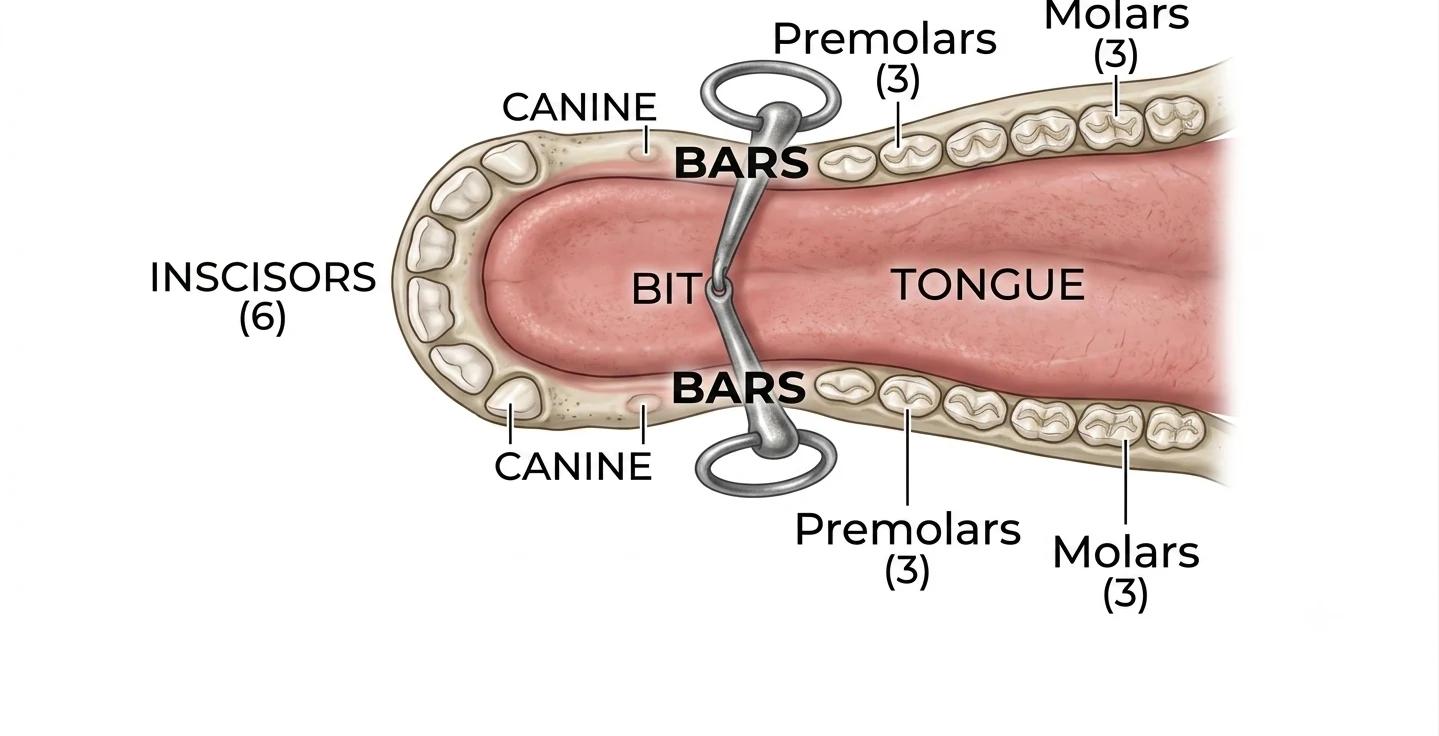
Before you can assess bit fit, you need a working understanding of what is inside the mouth and why each structure matters. The bit does not sit in empty space — it contacts specific tissues, and those tissues have different tolerances, different nerve densities, and different roles in the horse's communication with the rider.
The Bars
The bars are the toothless gap between the incisors and molars on the lower jaw — the interdental space where the bit mouthpiece sits when the horse is bitted. They are not soft tissue. The bars are cortical bone covered by a thin layer of periosteum and mucosa. There is almost no cushioning between the bit and the bone. Every time a rider applies rein pressure, that force travels directly to one of the hardest, least forgiving surfaces in the horse's body. Correct bit fit, correct bit choice, and correct rein use are not niceties — they are the difference between communication and pain.
The Tongue
The tongue fills the floor of the mouth between the bars and is, by mass, the dominant structure the bit contacts. It is dense muscle, highly vascular, and richly innervated. In a correctly fitted bit, the tongue absorbs the majority of pressure — this is by design. The tongue is better equipped to receive and transmit pressure signals than the bars because it can move, yield, and communicate without being damaged. A bit that sits too low, too wide, or is shaped incorrectly can shift pressure from the tongue to the bars, with consequences for comfort and responsiveness.
The Palate
The palate — the roof of the mouth — is relevant primarily when bits with high ports, severe ported mouthpieces, or incorrect sizing are used. A correctly sized snaffle with no port should not contact the palate at all. When it does, the horse has almost no way to communicate that discomfort except through tension, head tossing, and resistance to contact. The palate is one of the first structures to assess when a horse is exhibiting unexplained contact avoidance.
The Commissures
The commissures are the corners of the lips — the point where bit fit is most visually assessed, and where the wrinkle question lives. They are sensitive tissue, and a bit that pinches, pulls sideways, or sits at the wrong height will show its problems here first.
Bit fit is one variable in how your horse accepts contact. The quality of the leather bridle holding that bit is another — and choosing it well is just as important.
The Wrinkle Question — What It Does and Doesn't Tell You
The conventional wisdom is one to two wrinkles at the commissure. This is taught as the rule, repeated in every horsemanship clinic, and used as the primary assessment tool by most riders buying a bridle off the wall. It is a useful starting point and an imprecise one.
What wrinkles actually measure is whether the bit is high enough in the mouth to make contact with the commissures. That contact — gently lifting the corners — is what keeps the bit stable, prevents it from hanging too low on the bars, and maintains consistent position. So yes, some upward contact with the commissure matters. But the number of wrinkles produced is a function of the individual horse's lip conformation as much as it is of bit height. A horse with deep, fleshy commissures will show two wrinkles at a height where a fine-lipped horse shows none at all. Neither is wrong.
The Wrinkle Reference Guide
0 wrinkles — May be correct, or too low. A horse with fine lips or a naturally high commissure may show no wrinkle at correct height. Assess by watching the bit position relative to the bars, not the lips alone. If the bit is visibly hanging below the commissures, raise it. If it sits at commissure level and the horse is comfortable, zero wrinkles is fine.
1–2 wrinkles — The textbook answer, often correct. For most horses with average lip conformation, one to two wrinkles indicates the bit is high enough to be stable and low enough to leave room for the horse to use his mouth comfortably. This is where you want to start. Verify with the other assessments below before stopping here.
3+ wrinkles — Too high in most cases. Three or more wrinkles usually means the bit is pulling the corners of the lips upward, reducing the horse's ability to relax his mouth, swallow, and use his tongue properly. Some horses with unusually mobile, fleshy lips may show three wrinkles at a reasonable height — but this is uncommon. Lower the bit and reassess.
“The number of wrinkles is a function of the horse's lip conformation as much as bit height. A horse with deep, fleshy commissures will show two wrinkles where a fine-lipped horse shows none. Neither is wrong.”
Bit Width: The Most Common Mistake
If there is a single fitting error that appears more than any other, it is bits that are too wide. The industry default — 5 inches — fits a narrow range of horses well and many horses poorly. Quarter horses, Arabians, warmbloods, and draft crosses have meaningfully different jaw widths, and even within breeds, individual variation is substantial.
A bit that is too wide does three things, none of them good. First, it slides laterally — when you pick up the right rein, the bit moves right before it applies pressure, dulling the signal and creating inconsistency. Second, a wide bit drops lower on the bars on each side because the rings or shanks are not flush against the lips. Third, and most insidiously, excess width allows the bit to rotate in the mouth, which means the mouthpiece is rarely sitting in the same position twice and the horse cannot learn to reliably anticipate contact.
How to Measure
The correct measurement for bit width is the width of the horse's mouth at the commissures, plus 2–4mm on each side. That small amount of clearance prevents pinching without allowing lateral slide. To measure: use a piece of string or a bit-measuring device (a thin wooden dowel works) and measure from commissure to commissure. Compare that number to your bit's mouthpiece length. Most bits are measured from ring to ring on a snaffle, or from cheek to cheek on a pelham — know what you are measuring against.
In practice: if you can fit more than 3–4mm of space between the ring of the bit and the horse's lip when the bit is centered, the bit is too wide. If the rings are pressing into the cheeks, the bit is too narrow. Both are common; wide is more so.
The Pinch Test
For snaffles: with the bit correctly positioned in the mouth, gently push the bit toward the right. If there is more than 4mm of lateral movement before the left ring touches the left commissure, the bit is too wide. A correctly sized snaffle should be snug without pinching — you should feel the ring just touching the corner of the lip on the opposite side of the movement.
This test also reveals whether a D-ring or full-cheek snaffle is giving you the lateral stability it is supposed to. If the bit slides before the cheekpiece engages, you are getting none of the cheek ring's intended benefit.
Tongue Pressure vs. Bar Pressure
All bits exert pressure somewhere. The question is where — and whether that distribution matches what you intend and what your horse can comfortably receive.
Bar Pressure — bone under thin mucosa. Created by bits with narrow or flat mouthpieces that bridge over the tongue and land on the bars. Higher-severity bits concentrate pressure here. Horses with thin bars or previous bar damage are particularly sensitive. Bar pressure is not inherently wrong — but it escalates damage faster than tongue pressure and requires more precision in the rider's hand.
Tongue Pressure — the primary contact point. A correctly shaped mouthpiece with appropriate thickness distributes the majority of pressure across the tongue's surface. This is the intended mode of most snaffle bits. Horses vary significantly in tongue thickness and sensitivity — a horse with a large, fleshy tongue may actually find a thick mouthpiece more uncomfortable than a thinner one because there is less room for it.
Poll Pressure — gag and elevator bits. Bits with a sliding or elevator action (gags, American gag, three-ring) rotate the headstall forward and apply downward pressure on the poll as rein pressure increases. This is a separate pressure point from the mouth and must be considered when assessing total bit severity. Poll-sensitive horses may show resistance to contact that disappears entirely when the bit type is changed.
Chin Groove Pressure — curb bits and pelhams. Curb bits and pelhams apply pressure via a curb chain or strap in the chin groove below the bit when the shanks are drawn back. Correct curb chain fit allows two to three fingers between the chain and the chin groove when the shanks are at rest. Too tight and the curb acts the moment the rein is lifted; too loose and there is no curb action at all — just a heavier snaffle.
Mouthpiece Thickness and Severity
The received wisdom is that thicker mouthpieces are gentler because they distribute pressure over a larger surface area. This is true in principle and complicated in practice. A very thick mouthpiece in a horse with a small mouth or a large tongue creates a fit problem — there is simply no room for it to sit correctly. The tongue cannot drop, the horse cannot swallow comfortably, and what was supposed to be a mild bit becomes a source of constant low-grade discomfort.
The right mouthpiece thickness is the one that fits the individual horse's mouth. For most horses, 14–18mm is appropriate. Pony mouths are smaller; draft crosses may accommodate more. If a horse is showing tension, locked jaw, or resistance to contact with a thick bit, trying a thinner mouthpiece is often counterintuitive and often correct.
Bit Height in the Mouth
Height is the variable most directly controlled by cheekpiece length, and it is where the wrinkle rule lives. Too low: the bit rests on the bars with no support from the commissures, rotates freely, and produces inconsistent contact. Too high: the commissures are pulled, the horse cannot relax his mouth, and the ability to use the tongue as a signaling surface is reduced.
The Special Case of the Loose-Ring Snaffle
Loose-ring snaffles require slightly higher placement than fixed-ring bits. Because the ring rotates freely through the mouthpiece, a loose-ring sitting low in the mouth can pinch the commissure as the ring moves — the classic loose-ring pinch that sends horses into evasion. The fix is not to avoid loose rings but to ensure they sit slightly higher, with enough clearance that the ring's rotation does not catch the lip. Bit guards help; correct fit helps more.
Double Bridles
In a double bridle, the bradoon (small snaffle) sits above the curb bit in the mouth. Both must be sized and positioned correctly as an integrated system — not just individually. The bradoon should sit at standard snaffle height; the curb sits below it, resting further back on the bars. A double fitted with both bits at the same height, or with a curb that is too large for the space below the bradoon, creates a crowded mouth that makes it impossible for the horse to carry either bit comfortably. If your horse is resistant specifically in a double and willing in a simple snaffle, the fit of the two-bit system is the first place to look.
Signs a Bit Doesn't Fit
Horses communicate discomfort clearly. The problem is that bit discomfort often gets attributed to training, attitude, or breed temperament before fit is considered. If a horse is showing any of the following, bit fit and bit choice should be assessed before more schooling is applied.
Head tossing, particularly when contact is applied. This is one of the clearest signals that something in the mouth is uncomfortable. A horse who goes quietly on a loose rein and throws his head on contact is telling you that contact hurts. Check bit fit first, dental health second, and riding technique third — in that order.
Gaping mouth or crossing the jaw. A horse who opens his mouth wide under rein pressure, or who crosses his lower jaw sideways, is attempting to escape pressure he cannot absorb in the normal position. This is sometimes a training issue, often a fit issue, and almost always worth a vet and saddle-fitter check before it becomes a deeply ingrained evasion.
Tongue over the bit. A horse who gets his tongue over the bit is almost always doing it because the bit is too low, too wide, or too thin — creating a gap that the tongue can fill. It is not stubbornness. It is a fitting problem with a fitting solution.
Excessive salivation or foaming only on one side. Asymmetric foam can indicate asymmetric contact — often a width problem that causes the bit to sit unevenly. A horse who foams beautifully on the right and is dry on the left is worth investigating.
Resistance that appears suddenly in a horse who was previously accepting. Sudden bit resistance in a horse with no history of it is a veterinary question first. Dental issues, ulcers, and temporomandibular joint problems all manifest as contact evasion. Rule out pain before assuming training regression.
Once you understand how your horse's bit should fit, the next step is keeping all the leather around it in the condition that precision contact requires.
Knowing how a bit fits is one piece. Knowing how all of your horse's tack fits together — and what's worth buying — is another.
Frequently Asked Questions
My horse has always gone in a 5-inch bit. Do I need to measure?
Yes — especially if you have noticed any of the signs of poor fit above, or if you are riding a new horse. Five inches is the industry default, not a universal measurement. Many horses who have "always gone in a 5-inch bit" are actually going in a bit that is slightly too wide and have simply learned to accommodate it. Measuring takes less than three minutes.
Is a thicker bit always gentler?
Not in a small or crowded mouth. Thickness distributes pressure over a larger surface area — that is gentler when there is room for it. In a horse with a large tongue or a shallow palate, a thick bit leaves nowhere for the tongue to go and creates constant low-level pressure even with a completely loose rein. Match thickness to the horse's mouth, not to the general principle.
How do I know if my horse has thin bars?
Your equine dentist is the right person to assess bar condition. During a routine dental float, ask specifically whether the bars show any scarring, flattening, or periosteal reaction — all signs of previous bit pressure damage. Thin or previously damaged bars warrant a bit with more tongue relief and less direct bar contact.
Can I use the wrinkle rule on a Pelham or Weymouth?
Only partially. The wrinkle guide applies to where the mouthpiece sits relative to the commissures, which is the same regardless of bit style. But a Pelham and Weymouth also require curb chain assessment — something a wrinkle count tells you nothing about. Fit the mouthpiece height first using the standard method, then fit the curb chain separately.
My horse evades contact but the bit fits correctly. What next?
Start with a dental exam — teeth are the most overlooked variable in contact evasion. From there, saddle fit and a vet check for ulcers, ideally at the same time if you can arrange it. Contact evasion that persists after correct bit fit has been confirmed is almost always a pain response to something else. The mouth is where evasion appears; it is rarely where the problem originates.
The Elevated Tack Room Lookbook
15 finds every equestrian actually needs — curated, tested, and worth every penny. Free when you join the list.
No spam. Unsubscribe anytime.
Done
You're on the list. Check your inbox — your guide is on its way.