
This article contains affiliate links. We earn a small commission on purchases at no extra cost to you.
The entryway is the room most people design last and think about least. It shows.
A coat thrown over a banister. Boots in three different places. Keys on the counter, on the shelf, somewhere. The entry sets the tone for the house and for the morning — and most of them are working against the people who live in them.
“The right equestrian entryway decor does not announce itself. It reveals itself — in the weight of the hardware, the smell of the leather, the fact that everything in it was chosen rather than placed.”
Good equestrian entryway decor fixes this without a single horse print. Not with bridle motifs and themed doormats, but with the same logic that makes a well-organised tack room work: everything has a place, every place makes sense, and the whole thing runs without effort once it is set up right. Brass. Dark wood. Full-grain leather. A hook for everything that needs a hook. A surface for everything that needs a surface. A boot zone that makes getting out the door feel effortless instead of chaotic.
The principles behind why that works — material over motif, restraint over theme — are what separate an equestrian home that feels genuine from one that simply gestures at the idea.
This is how to build it.
The Door — First Impression Before You Are Inside
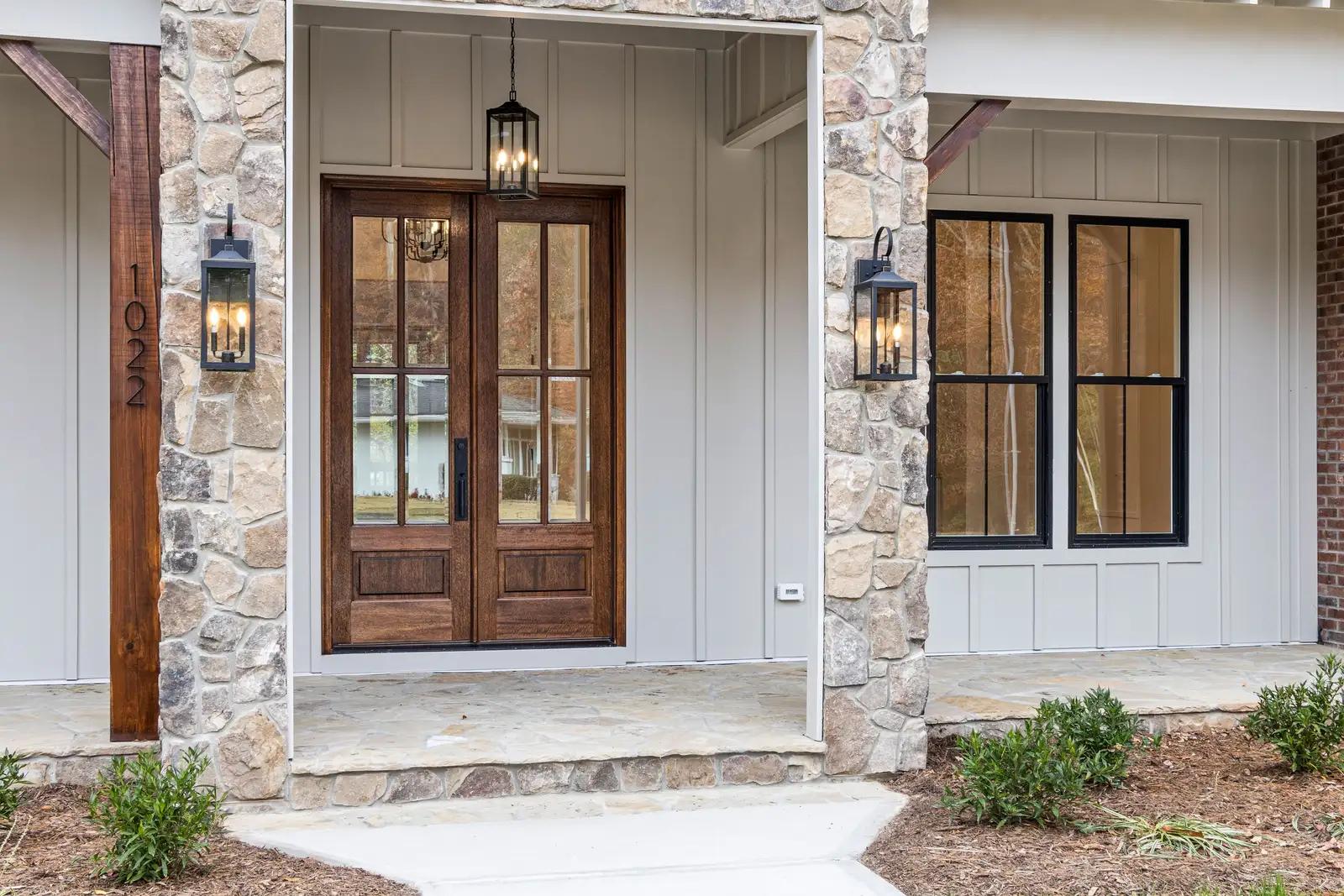
The door is the first thing. Before the hooks, before the bench, before any of it — the door either signals that what is behind it is considered, or it does not.
A brass door knocker is the right move. Not a chrome lever handle and a plastic doorbell. A solid brass knocker with weight and patina, the kind that makes a sound that carries. It is a detail most visitors will notice without knowing why — the door feels different, the entry feels intentional, and the whole thing reads as a home where someone made decisions rather than defaulted.
Aged brass is correct. Polished brass reads formal. Unlacquered brass, allowed to patinate naturally over time, develops the same warm irregular finish as old stirrup irons and good tack hardware. It darkens at the edges and brightens where it is handled. That is what you want.
The style should be simple. A ring knocker or a bar knocker in a clean silhouette. Avoid ornate motifs — the material does the work, the shape should stay quiet. A solid unlacquered brass knocker runs around $40–$120 from a hardware supplier, architectural salvage dealer, or estate sale. Avoid the lacquered versions sold at big-box home stores — the coating yellows within a few years and cannot be reversed without professional stripping.
The Hook Wall — The Foundation of Equestrian Entryway Decor
Every well-run equestrian life has a hook wall. At the barn, it is where the halters go — each one in its place, each horse's gear recognisable at a glance. The same logic belongs at the front door.
The hook wall is the first stop when you come in. Coat on a hook. Bag on a hook. Riding jacket on a hook. The system works when the hooks are in the right place, at the right height, and there are enough of them.
Vintage-style coat hooks
The hardware matters more than the number. A row of vintage-style solid brass coat hooks — individual hooks spaced eight to ten inches apart, not a mass-produced rack — reads entirely differently from a powder-coated steel multi-hook unit. The individual hooks have presence. They look like they were considered. Five hooks across a narrow wall is enough for a household of one or two; seven for more.
Mount them at 66 to 68 inches from the floor — the standard coat hook height that clears a long riding coat without requiring a stretch to reach. Individual solid brass hooks run around $15–$35 each. Five across a standard wall — roughly $100–$150 total — does more visual work than any piece of art the same money could buy.
The leather halter
One hook — the one at the end, or the one given the most wall — holds a leather halter. Not a synthetic halter. Not a halter from the reject pile. A clean, conditioned leather halter in dark brown or black, hung deliberately on a solid brass hook.
It reads as art to a non-rider. It reads as home to anyone who has ever run a hand down a horse's nose in the half-dark before a ride. That is exactly the effect.
Barn objects repurposed
The hook wall is also where barn objects earn their second life.
A hay hook or crop hung on a hook beside the coats functions as a bag hanger and signals the same easy, unselfconscious relationship with equestrian life that makes this aesthetic work. It is not decoration — it is the thing that goes there because it belongs there, and because the person who lives here is someone who rides.
A lunge whip leaned in the corner at the end of the wall does the same work as a walking stick or an umbrella in a traditional English entry. It belongs there. It looks right. Leave it.
“The hook wall is the tack room logic applied to the front door. One place for everything. Everything in its place. The whole system visible at a glance.”
The Console Table — Where Things Land
Every entryway needs a surface. The console table is where the mail goes, where the lamp lives, where the one object that deserves to be seen sits without competition.
The right console for an equestrian entryway is narrow — fifteen to eighteen inches deep — solid wood, dark finish. It should not dominate the space. It should anchor it. Mission-style or Arts and Crafts silhouettes in walnut or dark oak work without requiring explanation: the form is quiet, the material does the talking, and the proportions suit a hallway that needs to function as a passthrough.
Online Amish Furniture makes several console-depth occasional tables worth considering. Made to order, solid hardwood throughout, in your choice of species and finish. The lead time — eight to sixteen weeks — is part of the point. You are commissioning a piece, not buying furniture.
What goes on it
One lamp. A small object that means something — a framed photograph of your horse, a brass candleholder, a single thing chosen deliberately. A tray or a bowl for the things that would otherwise scatter. Nothing else.
The console is not a landing zone for everything. That is what the hooks are for, and what the catch-all is for. The console holds what deserves to be seen. In an equestrian home that one object is often a photograph — not a styled equestrian print but a real image of a real horse at a real place. That is the difference between a decorated entry and one that belongs to someone.
The Bench and Boot Zone
The bench earns its place in the equestrian entryway more than almost any other piece of furniture in the house.
You sit on it to pull on your riding boots. You sit on it when you come back in — to pull them off without tracking mud through the house, to take a breath before you are fully inside, to exist for a moment in the in-between space that every rider knows. The entryway bench is functional in a way that most furniture is not, and it should be built accordingly.
Solid hardwood. Simple lines. Mission or Shaker silhouette. Eighteen inches high — the standard seat height that lets you pull on a tall boot without contorting. Wide enough to sit comfortably, narrow enough to leave the walkway clear: thirty-six to forty-eight inches is right for most entries.
The McCoy Open Bench from Online Amish Furniture fits this exactly. Mission style, available in four widths from 36" to 72", designed explicitly for foyers and mudrooms. Mortise-and-tenon joinery — the product page confirms it. Made to order in twelve wood species with over seventy stain options. Around $539, with an eight-to-sixteen week lead time — you are commissioning a piece, not buying furniture. Choose walnut: the deep chocolate tone sits beside brass hardware and leather without needing to announce itself.
The boot zone
Beneath the bench is where the boot system lives.
Riding boots go in one place — upright, on boot trees if you have them, or on a low boot rack that holds them straight. Everyday boots in another spot. The floor beneath the bench is not for random shoes: it is a designated zone, and the zone works because everything in it has a defined place.
A boot jack tucked against the wall beside the bench adds the barn note that makes this feel specific rather than styled. It is a functional object — you use it every time you pull off a tall boot — and it signals something true about the person who lives here.
The Rug — Foundation of the Whole Entry
The rug sets the tone before anything else registers. Get this wrong and nothing else in the entry can fully compensate.
Natural fibre is the answer: jute, sisal, or flat-woven wool in a warm neutral. Dark enough to handle what comes in on a pair of riding boots, warm enough in tone to sit beside brass and dark wood without pulling cold. A dark border adds definition without pattern.
Pile rugs do not belong at the front door. They trap debris, they wear unevenly, and they look defeated within a season of real use. The equestrian entry gets mud, grit, and hay — sometimes all three on the same morning. The rug needs to handle this honestly.
Size up. The rug should extend past the full swing of the door and run the length of the bench. A rug that is too small makes the entry feel provisional. One that fills the floor properly makes the whole space feel settled. For most standard entryways, a 3×5 foot rug is the minimum — 4×6 is usually right. A quality natural fibre entryway rug runs around $60–$150, making it one of the highest-return investments in the space.
The Mirror — Proportion and Frame
A mirror in the entryway is functional — you check yourself before you leave — but it is also the piece that makes the space feel complete. Without one, an entryway feels unfinished regardless of what else is in it.
The frame should be thin. Aged brass or dark wood, no more than an inch wide. The mirror is not the focal point; it is the thing that reflects the focal points back into the room and adds light without a fixture. An ornate frame competes with the hardware on the hooks and the texture of the leather. A thin frame disappears correctly.
Size: full-length if the wall allows. At minimum, large enough to see your face and shoulders — not a small decorative mirror that serves no practical purpose. The test: can you check your collar and your coat before you walk out? If yes, the mirror is the right size.
Height: centre it at eye level, or hang it higher to lean at an angle if the entry is narrow and a protruding frame would crowd the space.
The Keys and Sunglasses Hook — The Habit That Changes Your Mornings
This is the smallest detail and the one that has the largest effect on how the entryway actually functions day to day.
One dedicated hook — or two, side by side — at eye level beside the door. Keys on the left. Sunglasses on the right. Every time. Not sometimes. Every time.
The hook is a single motion. You walk in, you hang your keys without thinking about where they go, because there is only one place they go. Sunglasses beside them, same motion. The next morning you leave and both are exactly where they were when you came in.
The alternative is a bowl. Bowls require you to search. You put things in, things pile up, and the thing you need is at the bottom under three other things. A hook eliminates the search entirely.
For an equestrian entryway: a single brass hook or a small double hook in aged brass, mounted beside the door at eye level. It should look like it belongs there because it does.
“When everything has one place and that place is obvious, the entry runs itself.”
The Catch-All — Everything Else That Needs a Home
The catch-all lives on the console table. It is a tray, a small bowl, or a leather-lined box — something with defined edges that makes clear where things go and prevents the surface from becoming a scatter zone.
It holds the things that do not have their own hook: lip balm, a spare hair tie, a folded note, the things that end up in a coat pocket and need somewhere to go when the coat comes off. Small. Edited. Not a dumping ground.
Ivy Cove makes leather catch-all trays in full-grain leather that do this correctly — the Catalina Catch All is the piece when it is in stock. The material sits naturally beside everything else in an equestrian entryway: the brass, the dark wood, the leather of the halter on the hook. One material repeated across multiple objects creates coherence without effort.
If the Ivy Cove tray is unavailable, any small leather or brass tray with defined edges works. The object matters less than the habit: everything that comes out of a pocket goes in the tray. Every time.
Lighting — Warm, Not Overhead
The entryway lighting most people have is a single overhead fixture: bright, direct, and wrong.
Overhead lighting in an entryway flattens everything — the texture of the wood, the sheen of the leather, the warmth of the brass. It is the light of a utility room, not a considered home.
A table lamp on the console is the correction. Iron or aged brass base, natural linen shade, bulb at 2700K or lower. The same material vocabulary as the rest of the entry — brass, iron, linen — and the same warm tone as a tack room lit for an early morning feed. The lamp throws light upward and outward rather than straight down, and the entry stops feeling like a corridor and starts feeling like the beginning of a home.
If there is no table to put a lamp on — or if the console is too narrow for one safely — a wall sconce in aged brass on either side of the mirror does the same work. Two sconces at eye level, warm bulbs, no overhead fixture at all. The brass of the sconces connects to the brass of the hooks and the door knocker, and the whole entry reads as one considered decision rather than a collection of separate choices.
Adapting Equestrian Entryway Decor to Your Specific Space
Not every entryway is a wide hallway with a full wall for hooks and room for a bench. Here is how to apply the same principles in tighter or more constrained spaces.
The narrow entryway
If your entry is under four feet wide, the bench goes against the wall at the far end rather than along the length — it reads as a destination rather than an obstruction. The hook wall stays: even in a 36-inch corridor, three hooks on one wall do not impede movement. The console table becomes a narrow shelf-depth piece (ten to twelve inches deep rather than fifteen to eighteen). The rug narrows with the space — a 2×4 runner is correct. Everything else scales; the principles stay the same.
Building it in phases
You do not need to do this all at once. The right order:
Phase 1 — hooks and rug (roughly $150–$250 total). These two changes do seventy percent of the visual work. Five solid brass hooks mounted at the right height and a natural fibre rug that fits the space properly transform the entry before a single piece of furniture arrives.
Phase 2 — the keys hook, the catch-all, and the mirror (roughly $50–$200). The functional layer. One dedicated hook beside the door, a leather tray on whatever surface exists, and a mirror at eye level. The entry is now working correctly even if it is not fully furnished.
Phase 3 — the bench and boot zone (roughly $400–$700). The investment piece. This is where the Amish bench earns its place — it is the piece worth waiting for, worth the lead time, worth choosing carefully. Once it arrives, the entry is complete.
Phase 4 — the console table and lighting (roughly $300–$800+). The finishing layer. A narrow solid wood console and a table lamp change the entry from functional to considered. Commission these after the bench so you know the space before you add more to it.
If you rent
The hook wall is still possible. Heavy-duty adhesive hooks rated for two to three pounds hold a coat without wall damage — not the right solution for a tall leather coat, but workable for lighter pieces and a single bag hook. A freestanding coat rack in dark wood or brushed brass does everything a mounted hook wall does without a single hole in the wall. A hall tree (combined mirror, hooks, and a small bench seat in one freestanding unit) is the renter's answer to building the full entry system without commitment. Look for solid wood construction — not particleboard — and aged brass or matte black hardware. The principles are identical. The mounting hardware is the only thing that changes.
What to Avoid
Equestrian-themed doormats. The ones with horseshoes, riding helmets, or the word "stable." They announce the aesthetic in a way that undercuts everything else in the entry. A plain natural fibre mat does more.
Multiple competing metals. Brass knocker, chrome hook, nickel mirror frame, black coat rack. Pick one metal and hold it across every piece of hardware in the entry. Aged brass is the right call for an equestrian home; it is the colour of a good stirrup iron, a well-worn bit, a tack trunk hinge that has been cleaned and conditioned for twenty years.
Prints and plaques. Motivational quotes, horse silhouette art, framed "live laugh love" adjacent sentiments. The entry should speak through material and object, not text.
Too many things on the console. If you cannot see the wood surface of the console table, there are too many things on it. Edit until you can.
Overhead-only lighting. Already covered. Replace it or supplement it. The entry deserves the same lighting consideration as any other room in the house.
Synthetic materials anywhere visible. Plastic hooks, laminate surfaces, polyester rugs. They do not age. They do not develop character. They look inexpensive immediately and only look more so over time. An entryway built from real materials — solid wood, brass, natural fibre, full-grain leather — looks better at ten years than it did at one. The synthetic version does not.
The Heritage Flow — When Your Equestrian Entryway Runs Itself
There is a point an entryway reaches when it stops requiring thought and starts running on its own. You walk in, and everything goes where it belongs — coat on the hook, keys beside the door, boots under the bench, bag on the low hook — without a single conscious decision. You walk out the next morning and everything is exactly where you left it.
That is heritage flow. The space organizes you instead of you organizing the space. It happens when every object has one place that makes instinctive sense, and that place is where it always is. Not because you built a system. Because the entry was considered enough that the right place was obvious from the start.
The equestrian home runs on this logic. The tack room that works is the one where you can find the right bridle in the dark, where every brush is in the same place it was the last hundred times you reached for it. The entryway that works is the same thing: calm, functional, and completely automatic.
Build it once, from real materials, with real hardware, with a hook for everything that needs a hook and a surface for everything that needs a surface. Then stop thinking about it. That is the point.
Once the entryway is right, the pieces that carry that same material language into the rest of the home are worth knowing — the full-grain leather goods, the brass accents, the heirloom furniture that earns its place in every room.
The same organizational logic that makes a well-run barn work — everything with a place, visible systems, nothing relying on memory — is the principle behind an entryway that runs itself. If you're building the barn at the same time as the house, the full barn organization guide is worth reading alongside it.
Frequently Asked Questions
What makes an entryway feel equestrian without being themed?
Material and restraint. Aged brass hardware, dark wood, full-grain leather, and warm neutral tones do the work without a single horse motif. The equestrian aesthetic is built on quality and function — an entryway that takes that seriously reads as equestrian to anyone who knows, and simply reads as beautiful to everyone else.
What should go on an entryway console table?
One lamp, one object that has meaning, one tray or catch-all for small items. That is the working formula. The console is not a display surface — it is where things land when you walk in the door. If it cannot hold a lamp, your keys, and your sunglasses without looking cluttered, it has too many things on it.
How do I create a boot zone in an entryway?
A bench with space underneath — either open shelving or a dedicated spot on the floor. Your riding boots go in one place, your everyday boots in another. A boot jack mounted to the base of the wall or tucked under the bench adds a barn note that is functional rather than decorative. The zone works when you can sit down, pull on your boots without thinking about it, and leave. That is the standard.
What type of rug works best in an equestrian entryway?
Natural fibre — jute, sisal, or flat-woven wool in a warm neutral. That is the short answer. Pile rugs trap mud and grit and wear unevenly within a season of real use. A flat-woven natural fibre rug handles heavy boots, wet days, and daily traffic without degrading. Add a dark border for definition. Size up — the rug should extend past the full door swing and run the length of the bench.
Why put keys on a dedicated hook instead of a catch-all bowl?
A hook is one motion — hang and leave. A bowl means searching. The difference in a morning when you are already running late is not small. One brass hook beside the door, used the same way every single time, eliminates the search entirely. That is the whole system.
How do I make my entryway more functional?
Assign every object that passes through your entry a specific place — not a general area, a specific place. Coat on the second hook from the left. Keys on the small hook beside the door. Boots under the bench, not beside it. Bag on the low hook, not on the bench seat. The entry becomes functional the moment everything in it stops requiring a decision. Until then, it is just storage you walk through.
The Elevated Tack Room Lookbook
15 finds every equestrian actually needs — curated, tested, and worth every penny. Free when you join the list.
No spam. Unsubscribe anytime.
Done
You're on the list. Check your inbox — your guide is on its way.